


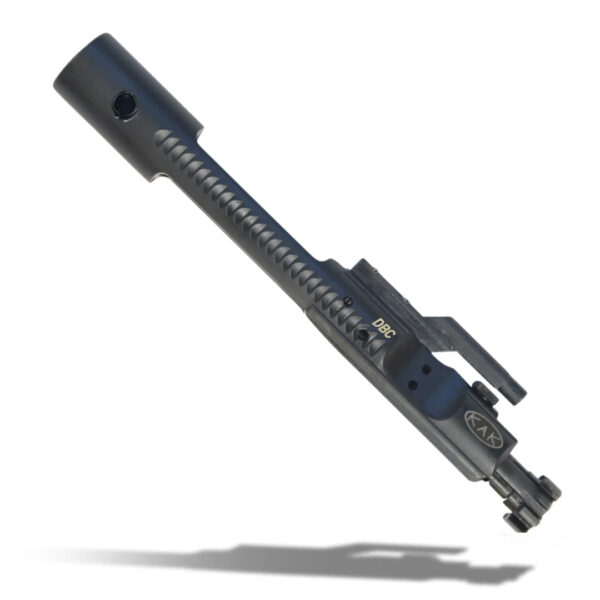
KAK Industry DBC K-SPEC BCG | First BCG Built for Assisted Reset Triggers | AR-15
FDC members buy at dealer pricing. Join free to unlock the price and add this to your cart.
Try FDC free today Already a member? Sign inDetails
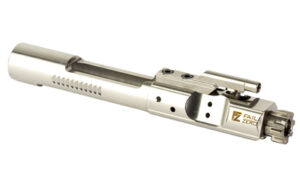
The KAK Industry DBC K-SPEC BCG is the first bolt carrier group ever engineered specifically for forced reset triggers. Every other BCG on the market was designed for standard semi-auto use — FRT builders adapted them as best they could, stacking buffer weight on buffer weight to tune reliability. The K-SPEC eliminates that problem entirely with a patented floating dead-blow weight in the carrier tail that allows any FRT to run on a standard 3oz carbine buffer — the one that came in your rifle.
The buffer tuning problem is the number one reliability complaint in the FRT world. KAK patented the solution.
The K-SPEC’s floating dead-blow carrier tail weight is a patented innovation — the first of its kind in the AR-15 BCG market. This is not a marketing claim. It is a granted US patent.
Every FRT on the market requires a heavier buffer — typically H2 or H3 — to function reliably. That extra weight slows bolt velocity enough for the FRT’s reset mechanism to engage before the bolt returns to battery. Get it wrong and you get bolt bounce, failure to reset, or the trigger locking up. FRT builders spend hours tuning buffer weight, spring rate, and gas settings chasing reliability.
The K-SPEC eliminates this. A floating weight inside the carrier tail creates a dead-blow effect — absorbing and counteracting bolt bounce mechanically, inside the BCG itself. Standard 3oz carbine buffer. No H weights. No tuning. Drop it in and run.
Confirmed FRT Compatibility — Tested by KAK Industry
KAK tested the K-SPEC with the major active reset systems on the market as part of the patent development process:
Hoffman Tactical Super Safety
AS Designs ARC-Fire FRS
Atrius Development FRS
Rare Breed FRT
Similarly designed FRT and active reset systems should also be compatible. As with all FRT builds, individual firearms may require fine-tuning — but the K-SPEC is specifically engineered to eliminate the buffer weight variable from that equation.
What Makes the K-SPEC Different
- Floating dead-blow weight — carrier tail — the core innovation. A weight inside the carrier tail moves independently during the BCG cycle, counteracting bolt bounce at the rear of travel. This is what allows a standard buffer to work with an FRT. Patent US 12,474,132 B2
- Single ejector — S7 tool steel — ground and heat treated. Maximum toughness and wear resistance at a high-stress contact point. Ejector hole centered on the lug maintains full bolt strength
- Downward gas venting — standard gas ports relocated from the ejection port side to the underside of the carrier in the magazine feed lip channels. Less gas to the face, reduced blowback, quieter suppressed report. Two additional emergency relief ports added at the bottom for structural protection in case of case head separation
- Standard carrier rails — chrome-lined — mil-spec carrier rail geometry, ground to .0002 tolerances for smooth, consistent cycling
- 9310 steel bolt — MPI tested — 9310 is the highest-strength steel used in AR-15 bolts. Every bolt receives magnetic particle inspection, the most reliable method for detecting internal defects. Outside diameters ground to .0002 tolerances
- 8620 steel carrier — chrome-lined — chrome lining on the bolt run, rails, and gas bores provides a harder, more durable surface for long-term cycling. Ground to .0002 tolerances throughout
- Permatex gas key seal — applied between gas key and carrier mating surface, preventing gas leakage at the key joint. Gas key is chrome-lined, hydraulically staked, and torqued to spec with T25 torx fasteners
- Suppressor-optimized no-tune — runs suppressed or unsuppressed with no changes to gas or recoil system. Zero additional tuning required
Component Steel Breakdown
9310 Steel — MPI tested, shot peened, phosphate finish, .0002 tolerance ground
8620 Steel — chrome-lined, phosphate finish, .0002 tolerance ground
8740 Steel — Swiss turned, heat treated, chrome plated
4140 Steel — Swiss turned, heat treated, phosphate
S7 Tool Steel — ground, heat treated (dual)
S7 Tool Steel — ground, heat treated
4140 Steel — fully machined, phosphate finish
4130 Steel — chrome-lined, hydraulically staked, T25 torx, torqued to spec
Full Specs
| Platform | AR-15 — all mil-spec uppers |
| Cartridge | .223 Remington / 5.56 NATO / .300 Blackout |
| Bolt Material | 9310 Steel — Magnetic Particle Inspected |
| Carrier Material | 8620 Steel — chrome-lined |
| Carrier Profile | M16 Full-Auto |
| Finish | Mag Phosphate — bolt and carrier exterior; Chrome-lined — carrier internals and gas key |
| Ejector System | Dual — S7 tool steel, mil-spec springs |
| Gas Venting | Downward — relocated to magazine feed lip channels |
| Carrier Rails | Standard — chrome-lined, ground to .0002 tolerances |
| Dead-Blow Feature | Floating weight in carrier tail — Patent US 12,474,132 B2 |
| FRT Buffer Requirement | Standard 3oz carbine buffer — H weights no longer required |
| Weight | 14.5oz |
| Dimensions | 7.7″ L x 1″ W x 1.4″ H |
| Country of Origin | USA — machined in-house, Missouri |
| Patent | US 12,474,132 B2 |
The K-SPEC is machined entirely in-house at KAK Industry’s Missouri facility using Doosan machining centers, Tsugami Swiss turning, and FANUC robotics in an automated cell with lights-out production capability. In-house automated CMM inspection processes ensure consistent quality on every unit. No outsourced components. No overseas machining. Every K-SPEC is made start to finish under one roof in the USA.
Frequently Asked Questions
Frequently Asked Questions
What makes the K-SPEC different from a standard M16 BCG?
Can I really run a standard buffer with an FRT using this BCG?
Which FRT systems has the K-SPEC been tested with?
What is the dead-blow floating weight?
Does the K-SPEC work suppressed?
What cartridges does the K-SPEC support?
Is the K-SPEC made in the USA?
Shipping & Returns
All sales are final; we do not offer refunds or exchanges. Items that arrive damaged or defective are covered under the manufacturer's warranty — contact us within 5 days of delivery and we will help coordinate a claim.
Related products
-
CMMG 22BA651 Bravo Compatible w/ 5.56/ .223 AR Platform Rifles 22 LR 25rd Includes 3 Magazines
-

Faxon Firearms FF556BCGCNITRIDELW Gunner Lightweight 5.56x45mm NATO, Salt Bath Nitride 9310 Steel For AR15 Rifle
-
Angstadt Arms AA45BCGNIT Bolt Carrier Assembly 45 ACP QPQ Black Nitride 8620 Steel for AR-15
-
Spikes ST5BG03 Bolt Carrier Group 223 Rem,5.56x45mm NATO Nickel Boron Steel AR-15, M16 Full Auto
-
FZ AR15 BOLT CARRIER GROUP